


Chapter 2 - Seeing Further

Once this is done and dusted, your life changes completely. Training becomes a habit—you start studying training plans, nutrition, bike accessories, new concepts for running shoes, and everything that takes place between lengthy sessions in the pool, where you constantly try to improve your stroke.
The more you think about it, the more you want to do it again. So you start looking around for more races and, if you’re like me and enjoy traveling, you immediately see the benefits of combining a triathlon with a weekend away.
But local races are often quickly organized, and if you’re not attracted by the charm of amateurism, you’ll soon start looking elsewhere for better-organized triathlons. Two names quickly stand out: Challenge and Ironman. The trouble is, the distances are longer—almost double your usual Olympic distance.
My first thought was to give it a go, just to try and see what it’s like. That was the first step toward giving up my resolution to switch from marathons to triathlons. I didn’t care how long it would take; suddenly, the four-ish hours could be dwarfed by my new sport, which would make me feel even better. A triathlete has to be able to endure longer events than a marathoner, and that’s a perfect example.
Plus, I had this wonderful bike, a brand-new wetsuit, and a running background—so I might as well put everything together over a longer distance and make the most of it.

So here I am, on a Sunday morning, on a beach in Majorca, wearing the same wetsuit, with the same bike racked and waiting for me, ready to see what it’s like to swim, bike, and run for 50% longer than it would take me to cover a marathon distance.
But before reaching this point, I had to clear a very important hurdle for any triathlete: logistics. A running competition is quite simple in terms of preparation for race day: a running top, shorts, a good pair of socks, and your usual running shoes—and you’re good to go. Add a state-of-the-art heart rate monitor or GPS tracking device, and you’ve reached the peak of what you need.
However, for a triathlon, you need to carry gear for all three activities—and that includes a bike. In my case, you can’t just stick your bike on your car and drive to Majorca; you have to fly there, which means dismantling the bike, packing it in a specially designed suitcase, and, most importantly, being able to rebuild it correctly without forgetting any bits and pieces, making sure everything is in the right place and tightened properly. Some shops offer dismantling and packaging services, but unless you plan to fly their staff to your destination, you’ll end up with a neatly packaged bike that’s much harder to ride. So there are few choices left, and the most obvious one is to try, learn, swear (if that makes you feel better), and do it yourself. And I did all that—especially the swearing part. But in the end, the bike was racked, and I was ready to race my first half-distance triathlon.
I must say the swim wasn’t much different from my first triathlon, except this time the water was salty—and it doesn’t leave a good taste in your mouth, as you inevitably swallow some. It’s important to have a bottle of water or isotonic drink in your transition bag so you can start the bike leg well hydrated. But first, the challenge is to find your transition bag—and that’s not easy, since each competitor has one, and they’re usually framed along short racks. Exiting the water near the front helps, as it considerably reduces the number of bags to search through. Of course, for those aiming for a good performance, mastering the skill of quickly finding your bag among hundreds is essential.
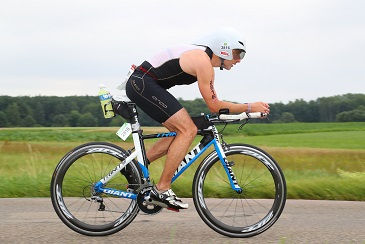
Once on the bike, I was off for 90 km—a distance I had never ridden before. After only 10 km, the road started to climb at a 6–8% incline, and that was the first time I had faced such a slope. You might think I wasn’t prepared for this race—and you’d be right. But it was only my second triathlon ever, and the idea was to get a taste of what a half-distance race feels like. The plan was actually to race later in the year—sometime in September or October—once I had more experience under my belt. But I had already chosen this race as my triathlon/travel weekend, so when the date was moved earlier in the year, I had no choice but to adapt—and to suffer.
And suffer I did, all the way up the hill. Everyone around me was suffering in silence, and it was quite a relief to go downhill, clocking some impressive top speeds and enjoying each tight corner with a sequence of braking, turning, and re-accelerating. But it didn’t take long for all the fellow racers I had overtaken to catch me once the road flattened again.
Later, as we headed toward the seaside and the finish line, the strengthening headwind took its toll too. All things considered, I was utterly shattered when I finally reached the bike park again. I swore several times on the bike that I would never do this again—convinced it was too long and that I should stick to the Olympic format instead. But one thing erased all those resolutions: the organization was so perfect that I couldn’t resist favoring the suffering over returning to local Olympic races.
By organization, I mean we rode on closed roads, without worrying about traffic at every intersection. Aid stations along the route offered all types of refreshments and nutrition, and photographers on bikes were stationed throughout the course to capture the moment—your moment. Overall, you end up competing under the same conditions as the pros, which is not only flattering—you can dream you’re one of them (as long as you ignore the crowd ahead of you)—but it also lets you focus solely on racing, which is a huge relief since that’s why you came here.
Once the second transition is reached, the same routine applies: find your bag, put on your running shoes, and start the next activity—this time, a 21 km run.
As soon as I hit the run, I usually feel better immediately and start off at quite a high pace. Then my legs remember the previous activities, and I start to slow down—gently but surely. I keep convincing myself that walking won’t help, and that I haven’t flown all this way just to walk, so I keep running. A good break comes at the aid stations, where walking is not only accepted but also helpful. If you don’t believe me, try drinking from a cup while running and slightly out of breath. Convinced now?
It’s also good for your mind, as it turns the 21 km run into shorter stints between rest periods. Just make sure you don’t overdo the resting, or your final time could suffer quite a lot.
So, roughly six hours after entering the Mediterranean Sea, I finished my first half-distance triathlon. I was relieved, tired, and sore—but I felt a great sense of achievement. I even celebrated that evening by eating an entire paella by myself, one usually big enough for two.
The next day is about packing the bike, enjoying your last few hours on-site, and catching a flight home—where you can once again enjoy rebuilding your bike.
Once I reflected on the weekend, I remembered the suffering on the bike and during the run, the soreness in my body, and the sunburns—but also the incredible conditions in which I raced.
I had only one conclusion: I need to train more so I can suffer less.
Comments